
Radio-nuclide Delivery System

NGSH-0708

Largest cancer treatment institution in Texas, USA had a need to install a state of the art Radionuclide Delivery System. CABI (Center for Advanced Biomedical Imaging) aims to be placed as a world leader in the use of PET for research in cancer patients. From the CABI website. The concept is to bring together under one roof basic and clinical-translational research, including computer-aided modeling of molecular structure and interactions for rational drug design, synthetic and analytical chemistry, molecular and cellular biology, immunology, stem cells, genetics, small animal imaging, large animal imaging and finally Phase 1 and Phase 2 clinical trials. The center will bristle with the latest imaging technology. Collaborator GE Healthcare will provide state-of-the-art magnetic resonance imaging (MRI), PET/computed tomography (CT) and volume CT for clinical use.
Introduction

Positron Emission Tomography (PET) is in use since early 80s as a research tool and since early 90s in a clinical role. The major clinical applications of PET are in the areas of oncology, cardiology and neurology. PET uses transient radionuclides to examine & operate on metabolic processes associated with health and disease. PET radionuclides are generated by cyclotrons. These radio nuclides need to be routed from the Cyclotron to the various labs with an automated system.

Key Objectives

Solution

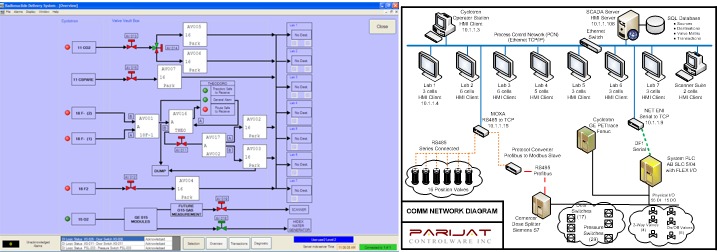
Parijat Controlware, Inc. were responsible for the hardware/software architectural design, supply, installation and GAMP-compliant validation of a state of the art control system capable of interfacing with a series of multi-position valves to deliver radionuclides from GE cyclotron to various destinations within the building including laboratory hot cells, a full-body scanner suite. The principle components of the control system (shown below) were a SCADA Server running under Microsoft Windows Rockwell PLC and seven all-in-one Asus touch-screen PCs wall-mounted via a swing arm. Regular desktop PCs running Microsoft Windows were used in the Cyclotron operator & the full body scanner operator. There was no 3rd party software used except to program the PLC. The system was well integrated that a single piece of information was only in a single place. Only commodity hardware & commodity software was used to avoid any future dependencies on any 3rd party vendors. Mechanism was available to update all the clients when any future changes are made or warranted. The database was on the centralized server and accessible from all the clients. Features were provided to easily setup a client in case of replacement. The PLC controlled the operator-selected routes by driving a combination of conventional 2-way solenoid valves and a series of VICI 16-way valves. The multi-way valves came complete with an RS485 interface module by which the position of the valve could be set and the actual position monitored. A special driver was developed for the VICI multi-way valves, loaded with retries & error reporting. A complete audit trail is available along with any events to comply with FDA & Gamp recommendations. These are stored in the MS SQL Server database & very powerful & user friendly reports are readily available. A interface to a Comecer supplied dose-splitting system was developed to send commands to it & to receive vital data from the unit. The Comecer communication is accomplished through the use of a Modbus-to-Profibus conversion interface.

Route Selection

A simple single-page, lab-specific, route matrix (see opposite) was developed for each screen to allow operators to select and subsequently open only valid route into that destination. Progression through the route opening sequence then took place via screen soft keys & user messages that were enabled at the appropriate time in the sequence. Most interaction took place at the lab-based displays, however, a double-check feature was incorporated such that any selected route had to be approved by the Cyclotron Operator which showed the current status of all the active routes to all destinations. The SCADA server is responsible for “watching” the status of all labs and selected routes. When any abnormal condition or fault occurs, the system will safely shutdown the route and bring all components to a “park” position. If any of these faults occur before the route is opened, the system will ensure that the route is not opened to prevent unsafe conditions. Although there were a total of 160+ possible routes, it was not possible for all routes to be active at the same time due to several factors which included common valve usage, and Cyclotron-imposed limits of a maximum of two routes being active at any one time and only certain target pairing combinations being valid. To cater for this, the PLC was configured to detect route conflicts and thus prevent the selection of an invalid route pairing. A single Sequential Function Chart (SFC) defined the structure of a route with “instances” of it being replicated for all others. Displays allowed the supervisor to note watch the status of all labs and intervene if any unsafe conditions could occur. The lab operators and the Cyclotron operator must both agree on a selected route before it can be opened. Once a route transaction is completed, the software will report all transactions, signal changes, and any errors that might have occurred. All events are stored for later review, if needed.

Interactive Simulation

A simulation mode was created to allow users to familiarize themselves with the use of the system. The users were able to interact with the system as if the valves were operating in the real system for training, testing & diagnosing. This training was beneficial via a reduction in the cost of training & retraining of users, removal of the need to arrange retraining at their own pace. Established in 1989, Parijat Controlware, Inc. is a Microsoft partner controls & IT company in the USA offering a unique combination of experience in FDA-conversant software design for worldwide applications of process control and engineering that allows us to provide a solution bridging the gap between industrial processes and the programmable systems designed to control them. This also allows us to integrate enterprise systems, business applications with the industrial control world in a seamless manner.

simulation

What other systems can it be connected to at a cancer hospital?

flow

This diagram shows how RNDS integrates with different hospital systems to safely produce, distribute, and use radiopharmaceuticals. Hospital Information System: Shares patient, scheduling, and dose data.
RNDS Orchestration: Central control system for dose routing, inventory, compliance, and secure device communication.
Radiopharmacy: Handles synthesis, quality checks, and dispensing of radiopharmaceuticals..
Dose Dispensing & Labeling: Ensures patient-specific dose preparation with accurate activity and timing..
Nuclear Medicine Imaging: PET/SPECT systems receive the prepared doses for diagnostic imaging.
Imaging Processing: Converts captured scans into structured data for analysis and planning.
Treatment Planning: Platforms like Eclipse/MIM/RayStation use imaging and dose data to create therapy plans.
Radiation Therapy Delivery: Executes treatment using LINAC, brachytherapy, or radionuclide therapy systems.
Environmental & Safety SCADA: Monitors radiation safety, interlocks, alarms, and contamination control.

Contact Us

Parijat Controlware

9603 Neuens Rd, Houston TX 77080

Tel: +1 (713) 935-0900

Email: sales@parijat.com